
RustFS for Tencent Cloud TKE Kubernetes Service
RustFS provides high-performance object storage for Tencent Cloud TKE with enterprise-grade features and multi-cloud capabilities.
Tencent Kubernetes Engine (TKE) is a fully managed Kubernetes service that provides high-performance, highly available container clusters and integrates with Tencent Cloud infrastructure and services.
Three reasons customers run RustFS on TKE:
- RustFS serves as a consistent storage layer in hybrid cloud or multi-cloud deployment scenarios.
- RustFS is a Kubernetes-native, high-performance product that delivers predictable performance across public cloud, private cloud, and edge environments.
- Running RustFS on TKE gives you flexible control over the software stack and avoids cloud lock-in.
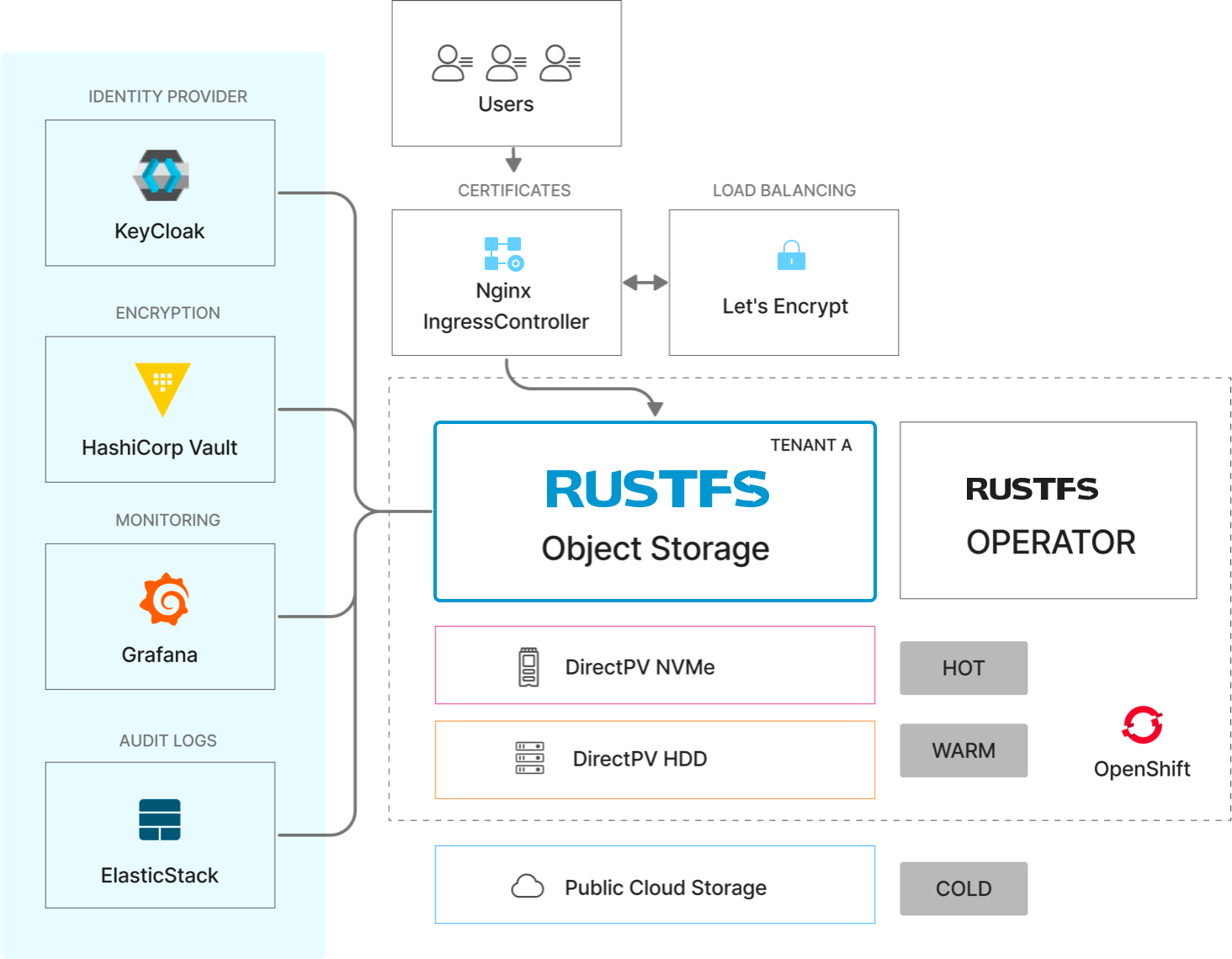
RustFS deploys on TKE with the official Helm chart, making it easier to operate your own large-scale, multi-tenant object storage as a service. Because RustFS is S3-compatible from the start, applications built for the S3 API run against RustFS on TKE without changes.
Prerequisites
Before deploying RustFS on TKE, you need:
- A TKE cluster with worker nodes sized for your storage workload
- A block-storage
StorageClassbacked by the Tencent Cloud CSI driver (for example, CBS disks) for RustFS persistent volumes - A load balancer for external access, typically a Tencent Cloud CLB provisioned through a
LoadBalancerservice or an ingress controller such as NGINX kubectland Helm configured against your cluster
Deploy RustFS on TKE
RustFS is deployed with its official Helm chart; no Operator or CRDs are required. Follow the cloud-native installation guide for the deployment steps.
Common Capabilities
Storage tiering, external load balancing, encryption and built-in KMS, identity management, TLS certificates, OpenTelemetry-based monitoring, and audit logging work the same on every Kubernetes platform. See RustFS on Kubernetes: Common Capabilities.